
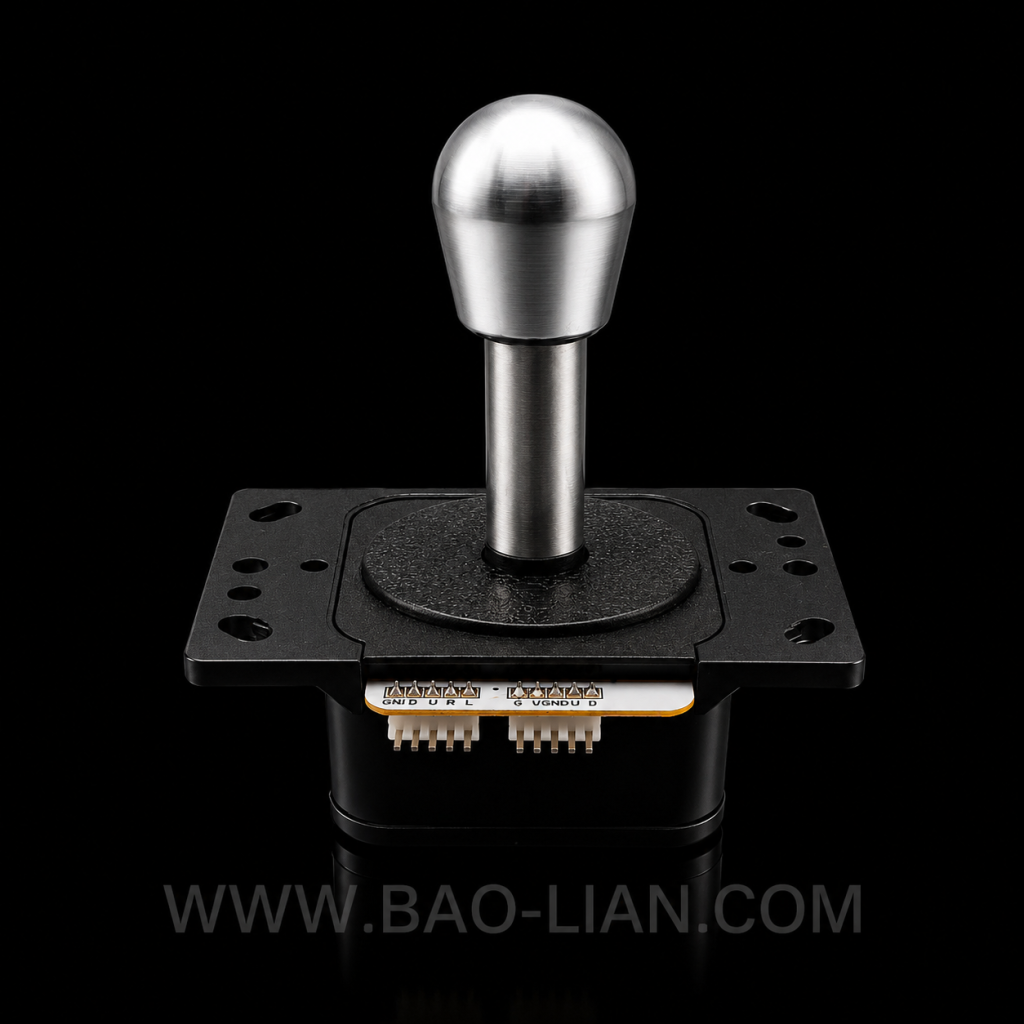
Ask what separates an American-style arcade joystick from a Japanese-style one and you will hear opinions all day. The short, practical answer: American sticks are built around a bat-shaped grip, a stiffer spring, and a longer throw — made for rough public use and the run-and-gun classics; Japanese sticks are built around a ball top, a lighter spring, and a shorter, faster throw — made for fighting games and precise repeated inputs. Neither is better. They are tuned for different games, different cabinets, and different players.
The parts that actually differ
Grip: the American bat top is taller and tapered, held loosely in the fist; the Japanese ball top sits under the fingers and favors wrist and fingertip control. This is the most personal difference, and adapters and threaded shafts mean you can often swap one for the other.
Spring and throw: American-style sticks resist more and travel further before the switch engages. That suits deliberate, directional games — platformers, shooters, track-style classics — and shrugs off abuse in busy venues. Japanese-style sticks engage sooner with less force, which is why quarter-circle motions and double-taps feel effortless on them.
Restrictor gate: most Japanese sticks ship with a square gate (corners help you find diagonals) and can swap to octagonal or 4-way. American sticks traditionally use round or 4/8-way switchable restrictors. The gate changes feel more than almost anything else, whichever family you choose.
Mounting: here is the trap for builders. American-style sticks usually mount under thicker panels (wood-era cabinets) with longer shafts; Japanese-style sticks assume thin metal panels and flat mounting plates. Before you commit to either, measure your panel thickness and hole pattern — swapping styles later can mean redrilling, which is a much bigger job than changing a spring.
Which one for which machine
- Fighting cabinets and tournament panels — Japanese-style ball top, short throw, square gate is the default the community expects; quick-release shafts make maintenance painless.
- Multi-game and retro cabinets running US classics — American-style bat top feels period-correct, and the stiffer action suits 4-way and 8-way classics.
- Claw, redemption, and amusement machines — the style matters less than the duty cycle; compact sticks with sealed construction and the right mounting plate win here.
- Mixed-use home builds — pick the style of the games you play most, and remember gates and tops can be swapped; sensing (microswitch or Hall-effect) is a separate decision from style.
Style and sensing are independent choices
A common mix-up: “American vs Japanese” describes geometry and feel, not the electronics. Either style can be built with conventional microswitches or with contactless Hall-effect sensing — we covered that trade-off in detail in our Hall-effect vs microswitch comparison. Decide the feel first, then the sensing based on how hard the machine works.
Both styles, from one factory
Baolian manufactures both families — American-style bat-top sticks, Japanese-style ball-top sticks, plus rotary, 4-way/8-way switchable, quick-release, and Hall-effect models — in illuminated and standard versions, 5V/12V, with or without PCB. Browse the full joystick range, and for machine builds, OEM programs, or a spec-matched recommendation, send your panel details through the contact page — our engineers will tell you which stick fits your machine, not just which one costs more.
Comments
No comments yet.